

Technological solutions
Behind every production process there is a fluid to be treated — and often more than one technology capable of doing so. The difference lies in knowing which one to choose.
Mecgem covers the entire spectrum of industrial fluid treatment: from crossflow filtration to reverse osmosis, from flotation to extraction. A broad portfolio, built over time through direct experience on real processes and different sectors. The solutions we propose are defined starting from your product, your process, your objectives.


Filtration is the transversal process par excellence: it mechanically separates the solid part from the liquid part and finds application in almost all sectors in which we operate.
Unlike traditional filtration, the flow runs parallel to the membrane, reducing clogging and ensuring process continuity. The application varies based on the molecular sizes to be separated:
Microfiltration (MF): removes suspended solids, bacteria, and macromolecules. Used for the clarification of food liquids and as pre-filtration.
Ultrafiltration (UF): retains viruses, proteins, and large organic molecules. Useful in byproduct recovery and wastewater pre-treatment.
Nanofiltration (NF): allows selective molecular separation (cut-off) — bivalent salts, sugars, low-molecular-weight organic molecules. Ideal for concentrating and partially demineralizing.

Plate filter presses: a consolidated solution for high-concentration solid-liquid separation and sludge dewatering. They ensure compact dry cakes and maximum recovery of the liquid phase.
Self-cleaning pre-filters: automatic systems positioned upstream of the main plants. They protect membranes and the most delicate equipment without interrupting the workflow.
What it addresses
Eliminate downtime for filter cleaning and ensure continuous production cycles;
clarify the product without altering its organoleptic, nutritional, or chemical qualities;
recover high-value molecules from waste or process effluents;
cold-concentrate a fluid, saving energy compared to thermal evaporators;
reduce sludge disposal costs through dewatering;
clarify water or effluents without using polyelectrolytes or aids.
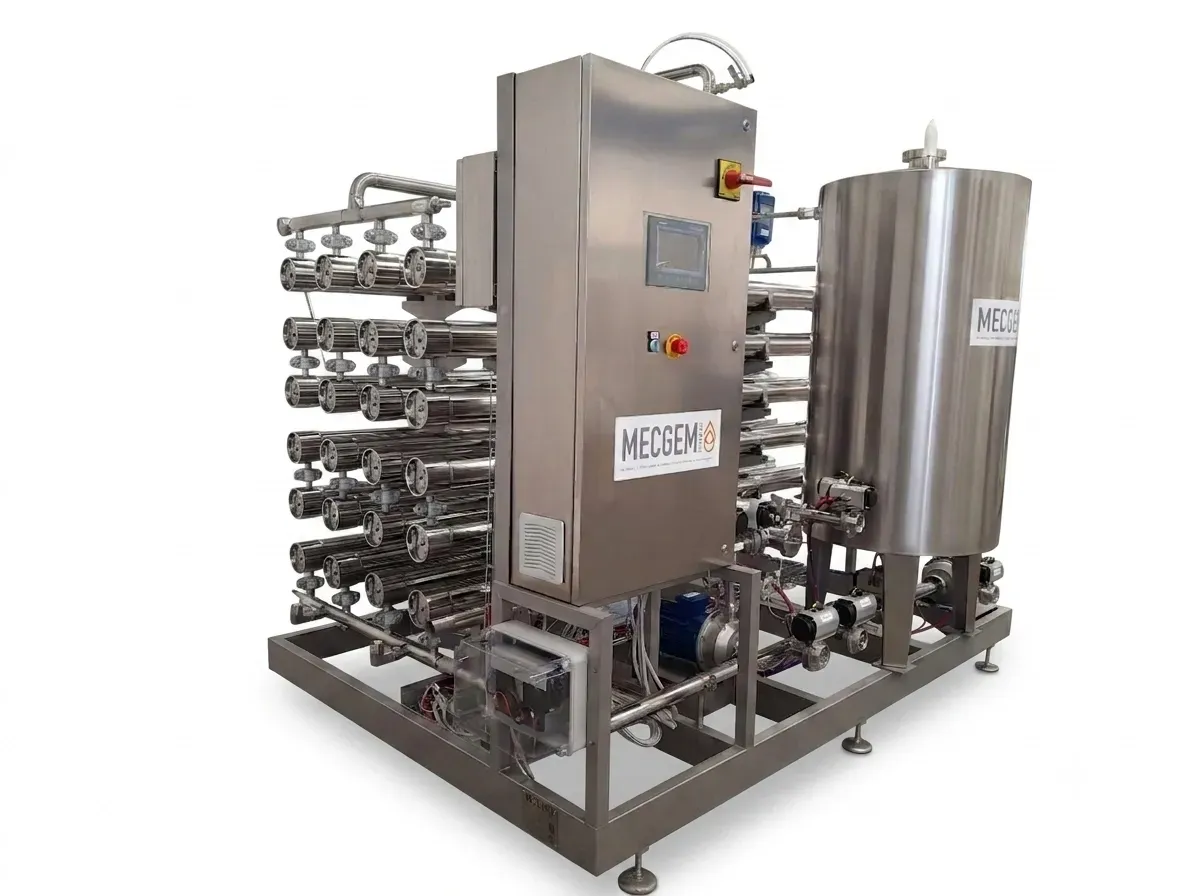
By applying pressure greater than osmotic pressure, we separate pure water from almost all dissolved salts and organic molecules present in the fluid.
What it addresses
Produce ultrapure water for the production process, where the presence of salts or contaminants can compromise an entire batch
Eliminate water discharge and recycle 100% of process water (Zero Liquid Discharge)
Concentrate a heat-sensitive product without the use of heat, keeping aromas and active ingredients intact
We eliminate unwanted pigments, organic contaminants, unusual odors, and flavors through beds of adsorbent resins and activated carbons selected based on the fluid matrix. Essential in the food industry — syrups, sugars, juices — and in the chemical-pharmaceutical sector for the purification of active ingredients.
What it addresses
Correct the color, odor, or taste of a product that does not meet aesthetic or commercial standards
Remove specific contaminants without disrupting the process, through selective purification

Through the introduction of air or gas microbubbles, we bring suspended particles — fats, oils, colloidal solids — to the surface, which are then mechanically removed. Key technology in the primary treatment of food and industrial wastewater: it rapidly reduces organic load and allows for the recovery of otherwise dispersed by-products.
What it addresses
In the food industry: rapidly reduce the suspended solids load and obtain a product with turbidity below 200 NTU.
Quickly comply with legal limits for discharge into the sewer system, reducing the presence of fats and oils in wastewater
Avoid overloading downstream treatment plants, continuously separating floating or colloidal substances

We design systems for the selective extraction of high-value components from solid or liquid matrices: active ingredients, polyphenols, antioxidants, aromas. Particularly suitable for the nutraceutical and pharmaceutical sectors and for the valorization of agro-food waste, transforming residues into new raw materials.
What it addresses
Create a new business line from agro-food waste, transforming waste into a noble raw material
Maximize the extractive yield of active ingredients, ensuring consistency and purity of the isolated product

The technologies we use are not separate modules. Each Mecgem plant can integrate multiple processes in sequence, building a customized line for your product and your goal.
An example: industrial wastewater can be pre-treated with flotation, refined through microfiltration or ultrafiltration, and finally concentrated with reverse osmosis or nanofiltration - returning pure water to the production cycle and reducing environmental impact.
Select your sector to see which technologies we can apply to your context and how.
Clarification of wine, juices, vinegar, and milk without altering the organoleptic qualities of the product.
Separation of lees and oils, with maximum recovery of the liquid phase.
Cold concentration of fluids: juices, musts, extracts. No heat input, intact aromas.
Clarification of liquid sugars, syrups, and juices to meet aesthetic and purity standards.
Separation of fats and oils in process water. Reduction of organic load before discharge.
Production of flavors, functional ingredients, and recovery of valuable components from processing waste.
Purification of solutions and culture broths with precise molecular size separation.
Process filtration in environments with high technical requirements.
Production of ultrapure water for process. Compliance with the most stringent industry standards.
Purification of chemical intermediates and active ingredients using selective adsorbent resins.
Isolation of active ingredients with maximum yield and consistent quality of the isolated product.
Concentration of active fractions and isolation of noble molecules with specific molecular cut-offs.
Filtration of plant extracts and complex biological matrices.
Cold concentration of aqueous extracts: no thermal degradation of active ingredients.
Decolorization of plant extracts to improve the final product's appearance.
Selective extraction of polyphenols, antioxidants, and functional molecules from agro-food waste using adsorbent filter beds.
Treatment and reuse of process water. Recovery of valuable molecules before discharge.
Dewatering of wastewater sludge to reduce volumes and disposal costs.
Total recycling of wastewater (Zero Liquid Discharge). Regulatory compliance and operational sustainability.
Removal of surfactants, dyes, and organic contaminants from complex wastewater.
Rapid clarification of wastewater and reduction of COD/BOD before final purification.
Recovery of valuable chemical components from process waste.
Answers to frequently asked questions.
We always start from the analysis of your fluid: chemical composition, maximum process temperature, solids concentration, and separation objective. From this analysis, we select the most suitable technology — or combination of technologies — and develop it tailor-made. We don't start from a catalog; we start from your process.
Yes. Mecgem works on product samples in the laboratory and, in a subsequent phase, if necessary, with a pilot machine directly at the client's site. This allows validating the actual yields before proceeding with the industrial plant.
Both. Not all projects require a totally custom plant - the costs would be excessive. Often, we start from a consolidated base to which targeted customizations are made based on the product and context. In any case, even with the most standard solutions, we don't leave the client alone: we follow them through every phase, because even seemingly similar products can have different needs.
Yes, after-sales assistance is an integral part of our service through customized service packages. All plants are remotely connected, which allows us to monitor their operation and intervene quickly if needed, often without requiring a physical intervention.
Can I combine multiple technologies in the same plant?
Yes, and it is often the most effective solution. Mecgem designs plants that integrate multiple processes in sequence - for example, flotation, ultrafiltration, and reverse osmosis - building a customized line for your product and your goal.
The first step is to understand your needs. Let's talk about it together.


